1927: The Big Four

Publishers: William Collins & Sons, 1927 (UK); Dodd, Mead & Co, 1927 (US)
Series: Hercule Poirot
Category: Novel
Cross refs: The Murder of Roger Ackroyd; The Pale Horse; The Secret of Chimneys; The Mystery of the Blue Train
Warning, spoilers!
As previously noted, there is a reason that Agatha Christie is celebrated for her country-house murder mysteries and not for her international espionage thrillers. While the former show her strength and originality as a writer, the latter can’t help but feel slightly derivative and, at times, a little absurd. It is to this latter category that The Big Four belongs. Though the book features the popular character Hercule Poirot, rather than exposing murderers on a domestic scale, our protagonist is set on the trail of four international master criminals.
Each of the ‘Big Four’ may be viewed as a personification of the perceived threats to society felt in Britain during the interwar period. They consist of Number One, ‘Li Chang Yen … the brains of the Big Four. He is the controlling and motive force’; ‘Number Two … is represented by an “S” with two lines through it – the sign for a dollar … he represents the power of wealth’; ‘Number Three is – the woman who is probably the greatest scientist in the world!’; and ‘Number Four … The destroyer’. These four figures are described as, ‘the force behind the scenes, which aims at nothing less than the disintegration of civilisation’. This is far from a case of a missing pearl necklace or a concealed will.
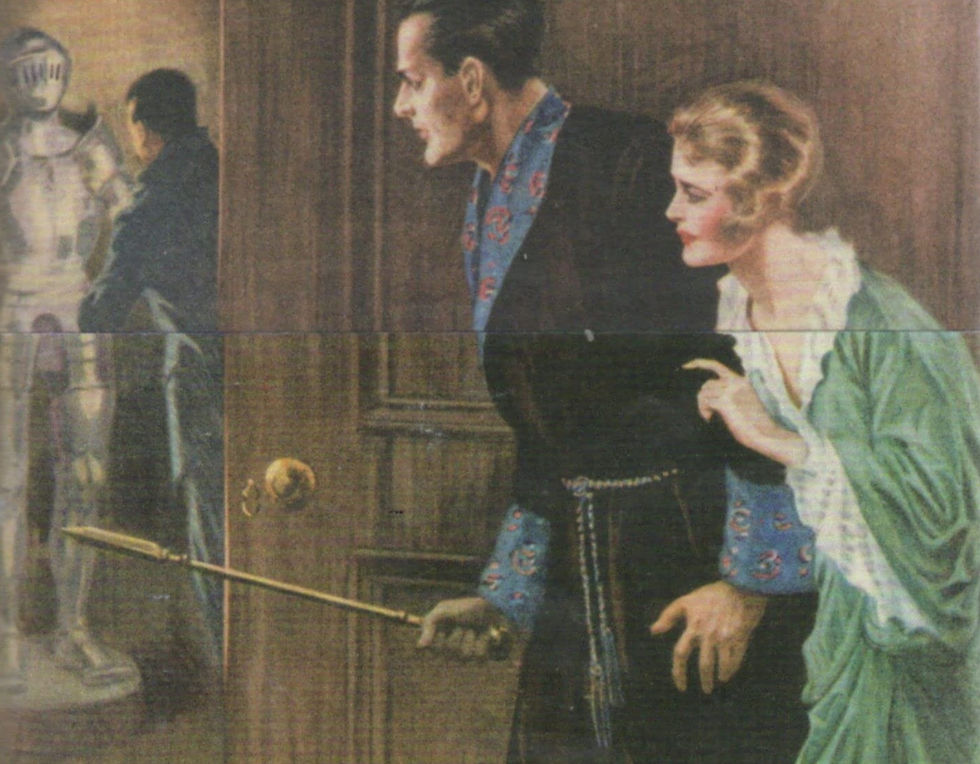
‘Number Four … The destroyer’.
The book proceeds in an episodic manner – Poirot investigates a crime that is, in some way, instigated by one of the Big Four; he solves the mystery but is simultaneously thwarted at the end, such that the members of the Big Four are able to escape. Poirot optimistically reframes this as a reconnaissance process, by which he is able to better know and understand his enemy; Hastings, on the other hand, feels less optimistic:
It was all very well for Poirot to say that we were acquiring information all the time and gaining an insight into our adversaries’ minds – I felt myself that I required some more tangible success than this. Since we had come into contact with the Big Four, they had committed two murders, abducted Halliday, and had been within an ace of killing Poirot and myself; whereas so far we had hardly scored a point in the game.
‘Since we had come into contact with the Big Four, they had committed two murders, abducted Halliday, and had been within an ace of killing Poirot and myself.’
Poirot does eventually gain the upper hand, and the book culminates, in the Dolomites, with a face-off between Poirot and the Big Four, in ‘a vast subterranean dwelling … hollowed out in the very heart of the mountain’. Quite.
The book feels like a series of disparate and sensational episodes, loosely strung together with Poirot and Hastings acting as the only binding force. It feels that way because, in fact, that is what it is. The novel was contrived, with the help of Christie’s brother-in-law (Archie’s brother) Campbell Christie (1893–1963) – ‘who had always been a great friend and was a kind and loveable person’[1] – from a series of 12 short stories published in The Sketch three years previously, to have ‘the appearance of a book’.[2]
In 1927, Christie owed her publisher a book. Yet, at that point in her life, she was ‘still unable to tackle anything of the kind’.[3] The Big Four, cobbled together with the help from her estranged husband’s brother, would be the ‘stop gap’ that she needed.[4] We can perhaps forgive Christie some of the sensationalism and absurdities of The Big Four when we consider the time at which this book was contrived. In April 1926, Christie’s mother, Clarissa Margaret Boehmer (Mrs Frederick Miller (1855–1926)) to whom she was devoted, died. This sent Christie into a depression that her husband could not handle. Rather than supporting his wife at her time of need, Archie Christie left her to sort out her mother’s home, with their young daughter in tow, and fell into the arms of another woman – Nancy Neele (1899–1958). Christie blamed herself for Archie’s infidelity, writing in her autobiography:
He had never been the type who looked much at other women. It was triggered off, perhaps – by the fact that he had missed his usual cheerful companion in the last few months.[5]
In December 1926, Agatha Christie famously disappeared from her home, Styles, in Sunningdale. Her Morris Cowely car was discovered at Newlands Corner in Surrey, parked above a chalk quarry and it was feared that she might have drowned herself in the Silent Pool, a nearby beauty spot. Some 11 days later she was found in Harrogate, staying in a hotel under the name ‘Mrs Teresa Neele’. Christie glosses over the episode in her autobiography, although she writes about the time prior, when she was sorting through her mother’s things:
I began to get confused and muddled over things … Sometimes I would sit down, put my hands to my head, and try to remember what it was I was doing … for the first time in my life I was really ill … I felt exactly like Alice in Wonderland touching the tree.
‘But of course’ I said. ‘I know my name perfectly well. But – but what is it?’[6]
Needless to say, there is perhaps little surprise that, in 1927, when this book was due, Christie wasn’t up to crafting a new and immaculately constructed novel.
Returning to The Big Four itself, the book offers some chronological continuity with the previous work, beginning with the return of Hastings to England from South America, where he and his wife had been living for the past year and a half. Poirot, who is clearly back out of retirement, is now acting largely as a ‘consulting detective’, and appears to have returned to his rooms in London from his rural retreat in King’s Abbot (perhaps understandable given the circumstances surrounding his time there; see The Murder of Roger Ackroyd (1926)). The dynamic between the two main characters remains in perfect balance, although Hastings does seem to have reached a new level of naïve ridiculousness, with Poirot observing at one stage: ‘I know, Hastings, that you have an imagination of the most fertile – but I implore of you to keep it within bounds.’
Inspector Japp makes a couple of appearances throughout the book, a reminder of the allegiance between the Scotland Yard man and the Belgian detective. This novel also introduces us to the jewel-thief the Countess Vera Rossakoff, to whom we discover Poirot has a soft spot and who we meet again in subsequent novels:
Poirot … always had a sneaking fondness for the countess. Something in her very flamboyance attracted the little man. She was, he was wont to declare in moments of enthusiasm, a woman in a thousand. That she was arrayed against us, on the side of our bitterest enemies, never seemed to weigh in his judgement.
We are also immediately reminded of Christie’s knowledge of poisons when the ‘unexpected guest’ of the first chapter is poisoned with prussic acid, which, we are informed ‘when inhaled, leaves no trace’. Poisoning by antimony is also mentioned, giving similar symptoms to arsenical poisoning. Later, she arms Poirot with a dart tipped in curare, a poison derived from South American plants. This was a poison that Christie learned about from a chemist that she worked with, a Mr P. She describes him as a strange and dangerous sort of figure; it was he who inspired her when she wrote The Pale Horse (1961). Of the curare incident she writes:
One day, seeking perhaps to impress me, he took from his pocket a dark-coloured lump and showed it to me, saying … ‘It’s curare … taken by mouth it does you no harm at all. Enter the bloodstream, it paralyses and kills you. It’s what they use for arrow poison. Do you know why I carry it in my pocket? … it makes me feel powerful.’[7]
Finally, one cannot write about The Big Four without noting the Orientalism and ‘othering’ that runs throughout this book. The leading force of the Big Four, Li Chang Yen, represents an idea of the East, an ‘other’ that, in the words of Mr Ingles, ‘we don't understand’ and ‘never shall’. The negative associations with this Eastern other are cemented in the words of Hastings at his capture: ‘I felt wrapped all round with the atmosphere of the East, tortuous, cunning, sinister.’
To what extent this was a reflection of Christie’s own attitude to the East it is not possible to assert, but to discount such attitudes of racism – as well as those of xenophobia and colonialism, which persist throughout Christie’s work (see also The Secret of Chimneys (1925)) – as merely a product of their time is an inadequate response.[8]
Writing on the subject of race, Professor Sam Naidu, a specialist in race and ethnicity in crime fiction, believes that Christie’s works ‘normalise racial prejudice’, adopting a ‘broadly racist and xenophobic stance in which those considered “foreign” from the British white hegemony are othered’.[9] This is undeniable, and something that a re-reading of Christie’s works has highlighted.
But the case has also been argued, notably by Professor Vike Martina Plock, that Christie ‘was not being racist herself in her novels, but rather reflecting the racist attitudes of her time and leaving them open to critique’.[10] Plock writes:
The racism depicted in the books draws attention to the fact that it was very dominant in the culture in which Christie was living. The 1930s saw the rise of the far right in Europe, leading to the Spanish Civil War and to World War Two, and [racism and] xenophobia were obviously rife.[11]
These are themes that we will have to grapple with again as we continue to make our way through Christie’s oeuvre. While they may sit uncomfortably, they are conversations worth having, for we cannot ignore the fact that racism was very much a part of the world in which Christie was writing, and continues to be a part of our world today.
The fact that The Big Four was published just a few weeks after Christie’s reappearance certainly helped the publicity for the book. In fact, sales more than doubled those of The Murder of Roger Ackroyd.[12] Yet the ordeal of writing The Big Four was something that remained with Christie and it is interesting to note that, in 1942, she wrote to her agent asking him to keep a manuscript in reserve, observing:
I have been, once, in a position where I wanted to write just for the sake of money coming in and when I felt I couldn't – it is a nerve-wracking feeling. If I had had one MS ‘up my sleeve’ it would have made a big difference. That was the time I had to produce that rotten book The Big Four and had to force myself in The Mystery of the Blue Train.[13]
‘That was the time I had to produce that rotten book The Big Four.’
And it is to The Mystery of the Blue Train that we go next.
[1] Christie 2011, p. 354.
[2] Christie 2011, p. 354.
[3] Christie 2011, p. 354.
[4] Christie 2011, p. 354.
[5] Christie 2011, p. 351.
[6] Christie 2011, pp. 348–9.
[7] Christie 2011, pp. 253–4.
[8] David Jesudason, ‘With Kenneth Branagh's second Hercule Poirot film out, Christie is hot Hollywood property once more. But how should adaptors navigate her books' attitude to race’, BBC Culture, 15 February 2022, https://www.bbc.co.uk/culture/article/20220214-death-on-the-nile-and-addressing-racism-in-agatha-christie [accessed 1 May 2025].
[9] Jesudason 2022, n.p.
[10] Jesudason 2022, n.p.
[11] Professor Vike Martina Plock cited in Jesudason 2022, n.p.
[12] Matthew Bunson, The Complete Christie: An Agatha Christie Encyclopedia (London, 2000).
[13] Quoted in Janet Morgan, Agatha Christie, A Biography (London, 1984), p. 163.

Comments