1926: The Murder of Roger Ackroyd

Publisher: William Collins & Sons, 1926 (UK); Dodd, Mead & Co, 1926 (US)
Series: Hercule Poirot
Category: Novel
Cross refs: The Murder on the Links; Cards on the Table; Murder at the Vicarage
Warning, spoilers!
There is a reason that Agatha Christie is remembered for her country-village crime stories. That when readers think of Hercule Poirot they think of a drawing room full of suspects, of – in the words of Dr Sheppard, narrator of the present book – a party assembled as if in ‘a trap – a trap that has closed’.
‘A trap – a trap that has closed.’
After emerging from a series of international thrillers, there is a quiet, simple perfection to The Murder of Roger Ackroyd. Christie’s forte is creating a web of intrigue on the domestic scale. Here her skills of observation, her ‘wonderful psychological insight into human nature’ (another quote from the present book) come to the fore. This is not only a well-crafted story, replete with twists and turns, that leans into the unsaid as much as the said, but it also proves that one doesn’t need to go to Africa or South America to spin a ripping yarn.
That said, ‘the Argentine’ does enjoy a brief mention, Captain Hastings having married Cinderella (see The Murder on the Links) has moved there to manage a ranch. Poirot, meanwhile, is enjoying retirement growing vegetable marrows and we first encounter him in this tale as he hurls one such marrow over the wall into his neighbour’s garden. Dr Sheppard recalls:
I was busily exterminating dandelion roots when a shout of warning sounded from close by and a heavy body whizzed by my ear and fell at my feet with a repellent squelch. It was a vegetable marrow!
… Over the wall, to my left, there appeared a face. An egg-shaped head, partially covered with suspiciously black hair, two immense moustaches, and a pair of watchful eyes. It was our mysterious neighbour, Mr Porrott.
As an aside, the decision by Poirot to grown this particular vegetable – and one which is mentioned time and again as epitomising retirement life – was no random choice. Christie observed in her autobiography:
Our first Dickens was Nicholas Nickleby, and my favourite character was the old gentleman who courted Mrs Nickleby by throwing vegetable marrows over the wall. Can this be why I made Hercule Poirot retire to grow vegetable marrows?[1]
It is no spoiler to note that Poirot quickly comes out of retirement (nor to mention that this yo-yoing in and out of retirement is a common theme in future novels). What is a spoiler, however, is the fact that our narrator throughout this tale – who, in many ways feels much like a proxy for the absent and trustworthy Hastings – is not always availing us of all of the facts. There are time lapses in his narrative that go unaccounted for:
The letters were brought in at twenty minutes to nine. It was just on ten minutes to nine when I left him, the letter still unread. I hesitated with my hand on the door handle, looking back and wondering if there was anything I had left undone.
As the narrator himself goes on to flag:
… suppose I had put a row of stars after the first sentence! Would somebody then have wondered what exactly happened in that blank ten minutes?
Similarly, the phrase ‘wondering if there was anything I had left undone’ leaps out like a red flag to anyone reading this book for a second time. As does the later phrase, when Sheppard is left alone with the body while Parker calls for the police: ‘I did what little had to be done!’
A monologue by Poirot points us further in the right direction:
Let us take a man – a very ordinary man. A man with no idea of murder in his heart. There is in him somewhere a strain of weakness – deep down. It has so far never been called into play ... But let us suppose that something occurs … He may stumble by accident on a secret – a secret involving life or death to someone. And his first impulse will be to speak out – to do his duty as an honest citizen. And then the strain of weakness tells. Here is a chance of money.
Finally, the game of Mah Jong, and how the characters play their hands, offers another insight into any hidden personality traits. Sheppard is quiet for most of the game, strategically holding back his tiles, allowing others to share gossip and play weaker moves, until he acquires the perfect hand. The pacing of the chapter is impeccable, with game moves interspersed between gossip and revelations, culminating in the Doctor’s victory. This use of a game to reflect personality traits was a technique that Christie used more overtly in her 1936 novel, Cards on the Table (as we will later discover!) where Poirot uses the bidding strategies, card play and reactions of the players as a window into their minds.
As is well recorded, the decision to make the narrator the murderer in the case of The Murder of Roger Ackroyd actually originated with Christie’s brother-in-law, James Watts (1879–1957):
… who, some years previously, had said somewhat fretfully as he put down a detective story: ‘Almost everybody turns out to be a criminal nowadays … even the detective. What I would like to see is a Watson who turned out to be the criminal’.[2]
Christie noted in her autobiography that Lord Louis Mountbatten (1900–1979; fig. 1) also wrote to suggest a similar twist – ‘that a story should be narrated in the first person by someone who later turns out to be the murderer’.[3]
Though now one of Christie’s most successful novels, the book has, however, been criticised in some quarters as ‘cheating’ the rules of the genre. Readers of detective fiction should have adequate clues, mixed among red herrings, to be able to solve the case. The Detection Club, of which Agatha Christie was a member, itself had similar rules to which its members were encouraged to conform. These included:
The criminal must be mentioned in the early part of the story, but must not be anyone whose thoughts the reader has been allowed to know.
And:
The ‘sidekick’ of the detective, the Watson, must not conceal from the reader any thoughts which pass through his mind: his intelligence must be slightly, but very slightly, below that of the average reader.
However, these rules were not constituted until March 1932, and so Christie could be forgiven for not strictly adhering to them!
That said, as Christie herself observes, if you read the book carefully, all of the clues are available. Christie’s friend and fellow Detection Club member, Dorothy L. Sayers (1893–1957), also spoke in defence of the book, asserting: ‘It is a reader’s business to suspect everybody.’[4]
‘It is a reader’s business to suspect everybody.’
The reviewer writing for The New York Times in 1926 agreed:
Miss Christie is not only an expert technician and a remarkably good story-teller, but she knows, as well, just the right number of hints to offer as to the real murderer. In the present case his identity is made all the more baffling through the author’s technical cleverness in selecting the part he is to play in the story; and yet her non-committal characterization of him makes it a perfectly fair procedure. The experienced reader will probably spot him, but it is safe to say that he will often have his doubts as the story unfolds itself.[5]
Aside from the adoption of a new narrative structure for Christie, another important feature of this book is that it offers us a glimpse into the nascent development of another household-favourite Agatha Christie character – Miss Marple. Dr Sheppard’s sister, Caroline, was Christie’s favourite character to write in this novel. She wanted to recreate this ‘acidulated spinster, full of curiosity, knowing everything, hearing everything; the complete detective service in the home’.[6] As Dr Sheppard observes of his sister:
Caroline can do any amount of finding out by sitting placidly at home. I don’t know how she manages it, but there it is. I suspect that the servants and the tradesmen constitute her Intelligence Corps. When she goes out, it is not to gather in information, but to spread it. At that, too, she is amazingly expert.
The reviewer from the Observer in 1926 clearly agreed that Caroline had potential of her own:
Miss Christie’s story is distinguished from most of its class by its coherence, its reasonableness, and the fact that the characters live and move and have their being: the gossip-loving Caroline would be an acquisition to any novel.[7]
‘The gossip-loving Caroline would be an acquisition to any novel.’
However, readers would have to wait until a murder at the vicarage in 1930 to enjoy the full realisation of Caroline’s character as Jane Marple.
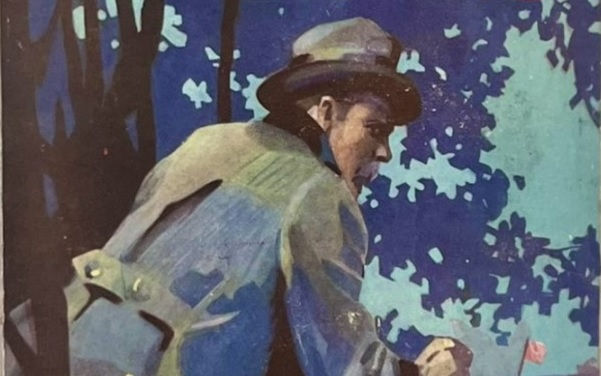
As for The Murder of Roger Ackroyd, the story first appeared in serial form in the London Evening News from 16 July to 16 September 1925, under the title Who Killed Ackroyd? In the US it was serialised (and heavily abridged) in Flynn’s Detective Weekly from 19 June to 10 July 1926 (fig. 2).
The Collins first edition of June 1926 was Christie’s first work for that publisher.
[1] Christie 2011, pp. 147–8.
[2] Christie 2011, p. 342.
[3] Christie 2011, p. 342.
[4] Quoted in Lucy Worsley, Agatha Christie: A Very Elusive Woman (London, 2022), p. 115.
[5] The New York Times Book Review, 18 July 1926.
[6] Christie 2011, p. 433.
[7] Observer, 30 May 1926, p. 10.
Comments