1929: Partners in Crime

Publisher: William Collins & Sons, 1929 (UK); Dodd, Mead & Co., 1929 (US)
Series: Tommy and Tuppence
Category: Novel/Short story collection
Cross refs: The Secret Adversary; The Secret of Chimneys
Warning, spoilers!
In Partners in Crime, Christie returns to the series-of-short-stories format and to her characters Tommy and Tuppence, the ‘young adventurers’ first introduced in 1922, in The Secret Adversary. Each of the short stories from Partners in Crime had been published in The Sketch variously between 1923 and 1924. Yet, despite its episodic approach, there is an overarching narrative, which revisits our protagonists six years on, enjoying married life, but with a restless Tuppence expressing a desire for ‘something to happen’. Tommy, who is now ‘more or less in the Secret Service’, is less keen for the romance and adventure that Tuppence craves, but when ‘the Chief’, Mr Carter, knocks at the door with a proposition for a little sleuthing, Tommy finds it hard to refuse.
The couple are to pose as ‘Blunt’s Brilliant Detectives’, with Tommy playing the role of the eponymous Theodore Blunt. They can run the agency as they wish, but must keep an eye out for letters pertaining to Soviet action. The actual Mr Blunt has, unfortunately, ‘been rather indiscreet’. Carter observes: ‘In fact, Scotland Yard have had to interfere. Mr Blunt is being detained at Her Majesty’s expense, and he won’t tell us half of what we’d like to know.’ It is, of course, pure coincidence that Christie chose the name of ‘Blunt’ for her Soviet spy, but one cannot help but think of Anthony Blunt (fig. 1) – one of the so-called ‘Cambridge Five’ – who was recruited by Soviet intelligence around this time, ‘as part of a new agent recruitment strategy, based on bright young Communists or Communist sympathisers from leading universities, who were told to break all links with other Communists and use their talents and educational success to penetrate the corridors of power’.[1] Anthony Blunt, of course, rose to the role of Surveyor of The Queen’s Pictures before eventually confessing to his role as a spy. Coincidence aside, this narrative thread pertaining to the threat from Russia tells us a little about the political milieu of the time, and rumbling concerns about Eastern Europe temporarily eclipsing anxieties over Germany.
The dynamic of the protagonists also reflects a post-war moment when younger generations were looking to establish themselves within a changing and uncertain world. As Tommy asserts:
The day of the Old Men is over … Who caused the war? The Old Men. Who is responsible for the present state of unemployment? The Old Men. Who is responsible for every single rotten thing that has happened? Again I say, the Old Men!
In terms of the agency itself, the 1920s saw a flourishing of private detectives, offering a range of services from locating missing individuals to investigating infidelity. Maud West (1880–1964; fig. 2) – self-styled as ‘London’s Lady Detective’ and famous for her range of disguises[2] – was perhaps the most prominent individual sleuth of the time, while renowned agencies included the previously mentioned Pinkertons National Detective Agency (see The Secret of Chimneys), Arrow’s Detective Agency and Chandler & Selby. Often staffed by ex-police officers and military men, these firms offered a wide range of services, as reflected in Tuppence’s enthusiastic outpouring at the news of the couple’s new posting:
It will be too marvellous … We will hunt down murderers, and discover the missing family jewels, and find people who’ve disappeared and detect embezzlers.
Just as this was the golden age of detective fiction, it was likewise the golden era of ‘classic sleuthing’, characterised by ‘handwritten notes, disguised identities, and long vigils from parked motorcars outside suspicious properties’.[3]
Tuppence is not the only one to embrace this new career opportunity: Albert (also introduced in The Secret Adversary), with his passion for cinema and for playing a character, readily takes up the role of ‘office boy’ at the agency, a part, Christie writes, ‘which he played to perfection’. ‘A paper bag of sweets, inky hands, and a tousled head was his conception of the character.’
Blunt’s Brilliant Detectives are poised ready. All they need now are clients …
A second narrative device that unites these short stories is the use of literary parody to mimic the styles of Christie’s contemporaries. Tommy refers to ‘the classics’ – fictional detectives from Thorndyke to Sherlock Holmes – as templates to replicate, both in terms of style and methodology.
In ‘The Affair of the Pink Pearl’, for example, Tommy takes on the guise of Dr Thorndyke, the ‘medical jurispractitioner’ created by the British author R. Austin Freeman (1862–1943). This, despite Tuppence’s observation: ‘You’ve no medical experience, and less legal, and I never heard that science was your strong point.’ Still, Tommy has a new camera and is keen to use it and to ‘enlarge the negatives and all that sort of thing’.
‘The Adventure of the Sinister Stranger’ references The Man with the Clubfoot (1918) by journalist and writer of crime fiction Valentine Williams (1883–1946). Meanwhile, at the start of ‘The Man in the Mist’, Tommy is dressed in clerical attire having attempted ‘the Father Brown touch’, a Roman Catholic priest and amateur sleuth created by G. K. Chesterton (1874–1936).
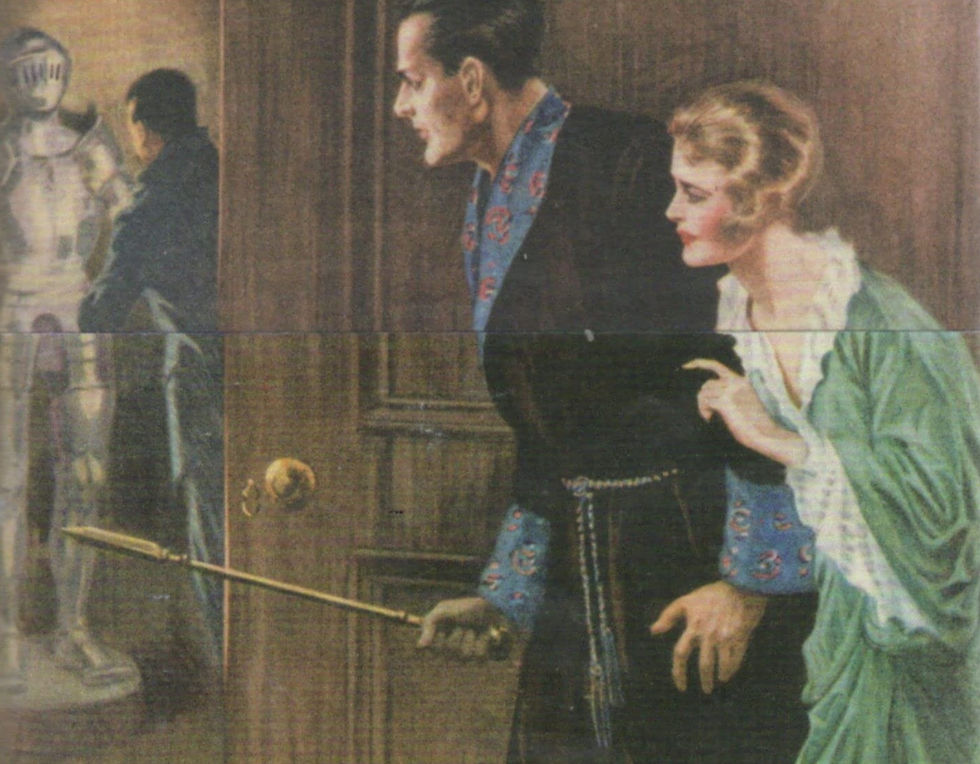
In ‘Finessing the King’, Tommy and Tuppence dress as Tommy McCarty (in disguise) and his partner Denis Riordan, characters created by the American mystery writer Isabel Ostrander (1883–1924). Most amusingly, Tommy tries his hand at mimicking Arthur Conan Doyle’s Sherlock Holmes in ‘The Case of the Missing Lady’, even referencing Conan Doyle’s story, ‘The Disappearance of Lady Frances Carfax’. Having already revealed ‘a somewhat futuristic dressing-gown, a Turkish slipper, and a violin’ earlier in the novel, here Tommy again picks up the violin and ‘drew the bow once or twice across the strings’, resulting in Tuppence grinding her teeth and the client somewhat blanching.
‘Blindman’s Bluff’ sees Tommy wearing an eye shade in tribute to Thornley Colton, the blind detective created by American screenwriter and author Clinton H. Stagg (1888–1916). Other authors parodied, or perhaps more correctly, paid homage to, include British writer Edgar Wallace (1875–1932) in ‘The Crackler’, Hungarian-born British novelist and playwright Baroness Orczy (1865–1947) in ‘The Sunningdale Mystery’; author and politician A. E. W. Mason (1865–1948) in ‘The House of Lurking Death’; Irish engineer and mystery author Freeman Wills Crofts (1879–1957) in ‘The Unbreakable Alibi’; British crime writer Anthony Berkeley Cox (1893–1971) in ‘The Clergyman’s Daughter’ and ‘The Red House’; author of detective fiction H. C. Bailey (1878–1961) in ‘The Ambassador’s Boots’; and Agatha Christie herself with the character Hercule Poirot, in ‘The Man Who Was No. 16’.
Christie later wrote that it was interesting ‘to see who of the twelve detective story writers that I chose are still well known – some are household names, others more or less perished in oblivion’.[4]
Reviewers praised this ‘hilarious burlesque of parodies’, with the New York Times Review of Books describing it as, ‘the merriest collection of detective stories it has been our good fortune to encounter’.[5] The rapport between Tommy and Tuppence was appreciated by The Scotsman, where it was observed that Christie did not ‘let her detectives win too easily. By having two detectives who are usually alternately successful she has always a foil, less obtuse than “my dear Watson”.’[6]
As with The Secret Adversary, this is a clever and witty page-turner, with the husband-and-wife team showcasing, once again, their inimitable flair and playful personalities.
[1] Christopher Andrew, ‘The Soviet Threat Between the Wars’, MI5, n.d. https://www.mi5.gov.uk/history/between-the-wars/the-soviet-threat-between-the-wars [accessed 22 June 2026].
[2] See Susannah Stapleton, The Adventures of Maud West, Lady Detective: Secrets and Lies in the Golden Age of Crime (London, 2019).
[3] ‘A Very British Mystery: The Colourful History of Private Investigators in the UK’, SIASS, 15 May 2025, https://www.siass.org.uk/post/a-very-british-mystery-the-colourful-history-of-private-investigators-in-the-uk [accessed 11 June 2026].
[4] Christie 2011, p. 433.
[5] The New York Times Book Review, 22 September 1929.
[6] The Scotsman, 16 September 1929.
Comments